
Source: Bao Dau Tu - read the original article.
Most of Tuong Vien Group’s factory leasing projects are occupied at an absolute rate. Construction quality and dedicated service are the key factors that sustain their long-term appeal.
As global manufacturing shifts, Vietnam’s industrial real estate market has entered a new competitive phase, where advantages are no longer limited to land bank or rental price, but increasingly depend on infrastructure quality, implementation speed and the ability to accompany investors.
In that context, Tuong Vien Group has remained consistent with its strategy of leasing land inside industrial parks to build factories for lease, serving FDI enterprises. Operating mainly in Trang Due, Nam Dinh Vu and Dinh Vu (Deep C) industrial parks since 2016, Tuong Vien Group has drawn attention not because of scale, but because of its almost absolute occupancy rate.
Mr. Do Trong Truong, Deputy General Director of Tuong Vien Group, shared with reporters the factors that determine the ability to fill factories and maintain the sustainable appeal of Tuong Vien Group’s facilities.
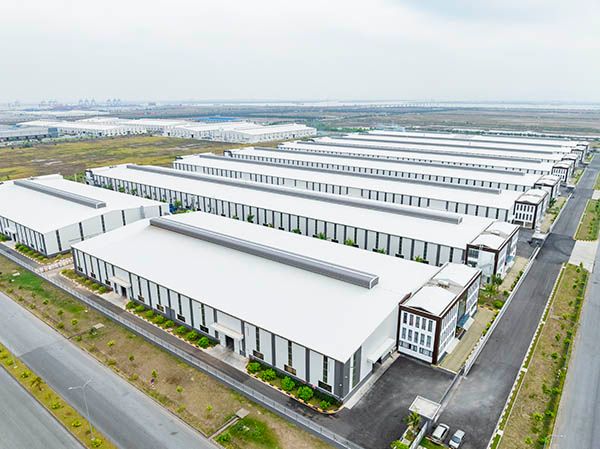
The high-quality factory-for-lease complex of Tuong Vien Group in Nam Dinh Vu Industrial Park, Hai Phong uses COLORBOND steel with AM-ACTIVATE coating technology for the entire building envelope.
Strategy for Fully Occupied Factories
In 2025 market reports, several consultancies said that under pressure from a sharp increase in supply, average occupancy in tier-1 northern provinces declined slightly, yet Tuong Vien Group’s projects reached near-absolute occupancy. What is the secret?
Over the past nine years, Tuong Vien Group’s factories have consistently met the standard of being filled as soon as construction is completed.
Our operating principles include three main factors. First, we build factories that fully meet the functional requirements of manufacturing enterprises. Second, we try to keep rents competitive with the market level.
Most importantly, Tuong Vien Group’s team provides maximum support to investors, from legal procedures for establishing the enterprise and investment project in the initial stage to issues that arise during production.
What target customer group is Tuong Vien Group currently focusing on?
At present, 100% of Tuong Vien Group’s customers are FDI enterprises. Around 80% operate under the export processing mechanism, meaning they manufacture and export 100% of their products.
Our customers are diverse, coming from South Korea, Japan, the United States, Russia, India and other markets. However, Chinese enterprises currently account for the largest share, mainly operating in light industry, electronics and assembly.
In your view, what are the key criteria that make investors choose to lease Tuong Vien Group’s factories instead of those of other providers?
When entering an industrial park, most enterprises have not yet determined long-term stability for their operations in Vietnam, so they often choose to lease factories instead of buying land.
Therefore, their first concerns are whether factory quality meets production requirements, whether the location fits their supply chain, and whether rent is competitive.
In addition, they pay close attention to factory functionality and whether transport infrastructure is convenient for import and export. In Hai Phong, for example, the advantage is very clear: the distance from production areas to export seaports is short.
The ability to recruit skilled labour in the area is also an important factor when enterprises make investment decisions.
You have repeatedly emphasized factory quality. What technical differences do Tuong Vien Group’s factories have?
We focus heavily on real operating functionality. For example, enterprises with large workforces must have adequate parking for workers and waste collection areas that comply with environmental regulations, so customers do not need to invest more.
Because we operate in a coastal area such as Hai Phong, we pay particular attention to roofs and building envelopes. From the beginning, Tuong Vien Group has used BlueScope steel for roofing to limit rust and leakage, protecting high-value machinery, equipment and goods inside.
Our view is that the building envelope must be truly durable to withstand the harsh weather and storms of Northern Vietnam.
Continuously Improving Quality and Service
Record FDI inflows and supply-chain shifts are creating a vibrant playing field in industrial real estate. How do you assess the market ahead, and what is Tuong Vien Group’s expansion direction?
I believe there will be a wave of production relocation from countries subject to high tariffs, especially China, to Vietnam. In that context, factories for lease will be a strongly growing segment because they can be put into operation immediately and require lower initial investment costs.
However, the coming trend will be greener and cleaner factories that meet strict European standards to facilitate exports. Factors such as rooftop solar power and internal roads wide enough for container trucks will receive special attention from customers. Tuong Vien Group will capture these opportunities.
In the coming period, Tuong Vien Group plans to develop factory-for-lease projects in Bac Ninh and Bac Giang, where many major FDI names such as Foxconn, Luxshare, Goertek and Samsung are investing heavily. We will focus on attracting suppliers for these large corporations.
What plans does Tuong Vien Group have for the smart factory segment?
We are not outside this trend and are currently conducting research. However, the concept of a smart factory still lacks a unified definition. Some enterprises understand it according to European standards, while others approach it according to Chinese standards.
Therefore, it is still not possible to define specifically what elements a smart factory must include. They may include solar power or AI-based goods tracking systems. Tuong Vien Group is researching to select applications that best fit customers’ real needs.
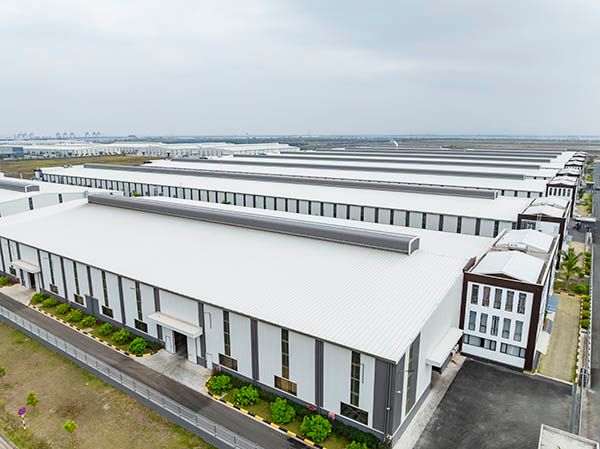
The building envelope of Tuong Vien’s high-quality factory-for-lease complex uses COLORBOND steel with AM-ACTIVATE coating technology for high corrosion resistance and longer building life under Northern Vietnam’s harsh climate conditions.
To improve competitiveness, what improvements will Tuong Vien Group make in materials and structures for new projects?
For internal traffic, roads need to be widened to serve goods transport vehicles, because when enterprises operate efficiently, import and export frequency increases. We cannot follow the mindset of maximizing the permitted construction density.
For example, many industrial parks currently allow a construction density of 60%. If the full 60% is used, the remaining area for greenery and traffic will be very limited and will not ensure smooth operations.
Factory durability is also extremely important. Previously, we used steel sheets for the building envelope, but now we are moving to panels to improve aesthetics, thermal insulation and sound insulation. Structurally, steel-frame factories will gradually shift to precast concrete frames, increasing stability and sustainability, especially for multi-storey factories.
During operation, we better understand the real needs of manufacturing enterprises and continue to complete auxiliary facilities so they meet operating requirements more effectively.
Tuong Vien Group’s Legacy Is Customer Trust
The concept of sustainable legacy is increasingly mentioned. How do you view this in Tuong Vien Group’s development, and what is the most important legacy the group must maintain?
For factories, sustainability is something any developer cares about; the difference lies in whether the chosen solution carries a high or low cost.
Tuong Vien Group’s view from the beginning has been to choose materials with high sustainability, such as using BlueScope steel for the building envelope. With nearly 10 years of operating experience, issues related to steel sheets have been very small and have not significantly affected tenant operations.
Auxiliary works may look like small items at first glance, but enterprises use them every day, such as pump stations, waste houses and air-compressor rooms. These items need to be carefully invested in, fit the landscape and be reusable over the long term.
More importantly, the spirit of customer care and support must be maintained and passed on to all generations of Tuong Vien Group employees. Most FDI enterprises newly entering Vietnam are unfamiliar with legal procedures. We carry out investment registration certificate and enterprise registration procedures completely free of charge, and accompany customers in applying for fire safety permits, environmental impact assessment reports, foreign labour registration and tax-related issue handling.
In some cases, we are willing to spend our own money to resolve obstacles. This is the core factor that has helped Tuong Vien Group maintain a high occupancy rate over time. It is also why a large portion of new customers come through referrals from existing customers.
With those directions, can you share a memorable experience working with foreign partners?
In 2020, a large Chinese group specializing in garden tools for export to the United States surveyed many locations. Eventually, they came to our factory system, where several units had just been completed. After comparing many places, they decided to sign the lease immediately when they learned that the factory roofs used BlueScope steel.
Another case involved Japan’s largest ATM manufacturer. They spent about three months surveying and approving the leasing process, but thanks to the dedicated support of our team, they stayed with Tuong Vien Group for six years and continued to trust us to find land and build a new factory three times larger to expand production. That is clear proof of the trust we have built.
In industrial real estate, the most important thing is to understand and help customers overcome cultural and legal barriers. Do not overcalculate small initial support costs, because their satisfaction will bring greater opportunities later through referrals.
The process must also be fast and concise, because customers cannot wait long. If we are cumbersome, we lose. Factory quality and dedication are the keys to sustainable success.
This article is republished from Bao Dau Tu. Read the original article at Bao Dau Tu.


